
The Maronite Cross May Change That
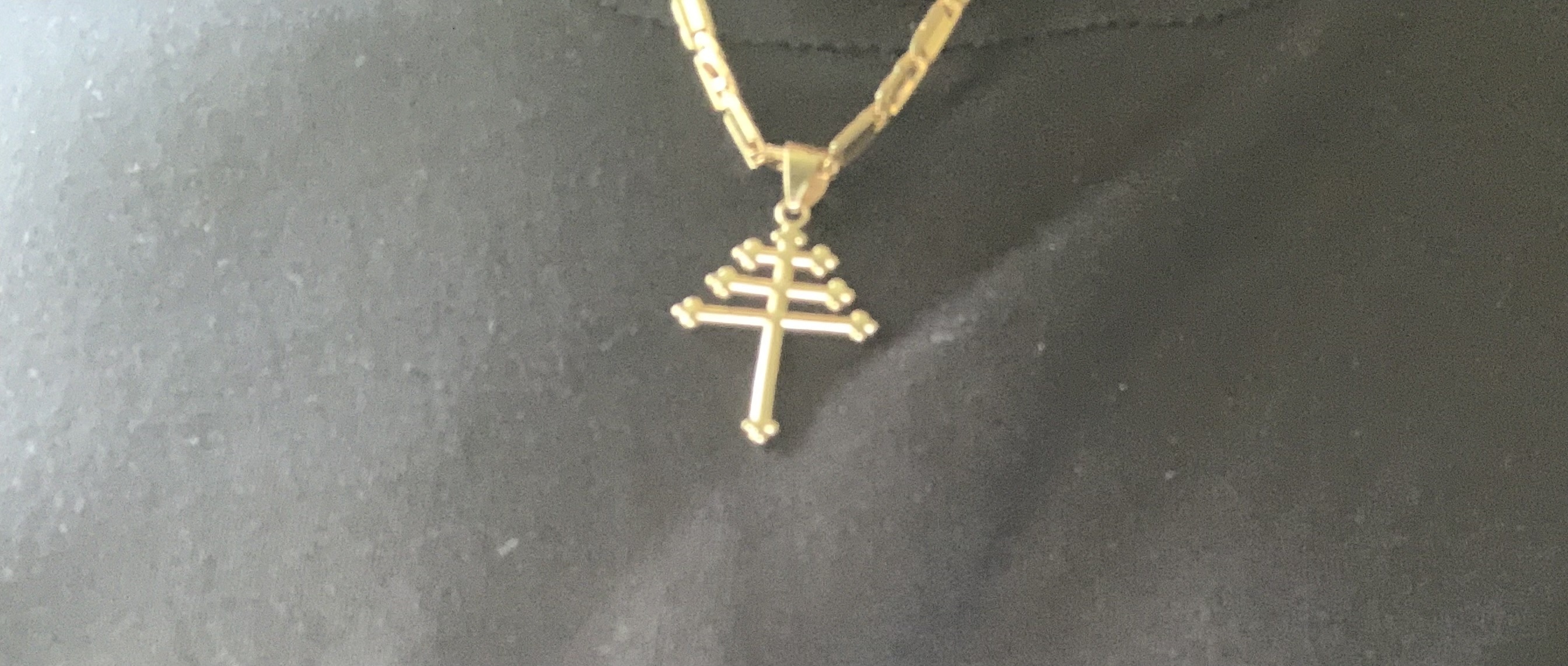
Photo by Barbara A. Besteni ©
While many symbols and sayings have resonated with me throughout my life, never has one resonated long enough for me to permanently ink it to my body.
Each time I thought, “This is it. This is the tattoo I will get!” another symbol or saying came along that meant more to me than the previous one.
Knowing that the symbols have changed so much throughout the years, I hesitated to get a tattoo. And I didn’t want just any cute thing adorning my body. No butterflies or hearts for me.
I wanted a tattoo that would mean something to me and be a conversation starter with which I could share my more profound thoughts on life and spirituality with anyone who asked about it.
Nothing fit the bill.
But as I begin my 66th trip around the sun, I think a date with a tattoo artist is in my near future.
All Signs Point To Lebanon
I was born in Cuba to a Cuban mother born in Brooklyn and a Lebanese father born in Cuba. Although I was raised predominantly in the Cuban culture, my Lebanese heritage has always been a source of connection and belonging for me.
A few months after my father’s passing in 2015, I began seeing signs that resonated with my heritage.
They were too specific to be coincidence. They were more like messages from the beyond.
My father was a very spiritual man who embraced mysticism and the teachings of various religions. His beliefs were the foundation upon which I built my own beliefs.
He often spoke of the Phoenicians and, like many Lebanese people, was proud to identify with this ancient civilization renowned for its maritime trade and cultural influence throughout the Mediterranean and beyond. They also created the Phoenician alphabet, which became the basis for most Western languages today.
I never paid close enough attention or valued the treasures my Dad’s words and knowledge held while he was alive, but when he passed, his words echoed in my mind, and I felt his presence every day.
At first, I attributed this to grief. But the signs continued to get stronger long after my initial grief passed.
The Messages Would Not Be Denied
During the next few years, the messages from my father became even more insistent.
Out of the blue, one of my cousins gave my paternal grandmother’s Bible to my mom, who then gave it to me.
A few days later, a visit to Delray Beach prompted a chance meeting with the owner of a Lebanese restaurant. My partner, friends, and I passed the restaurant, but we didn’t stop. The restaurant owner, who was at the door when we went by, ran after us and invited us inside.
He and I struck up a conversation about grandmother’s Bible. During that conversation, he introduced me to St. Charbel, a 19th-century Lebanese Maronite monk and priest known for his holiness, miracles, and ability to unite Christians and Muslims. In 1977, Charbel was canonized by Pope Paul VI.
I had never heard of St. Charbel. The restaurant owner just happened to have a card with information about the saint, which he gave me so I could do further research. He apologized that the card was written in Spanish because he had no English ones left. I am fluent in Spanish, and it was my father’s preferred language.
The signs continued.
Perusing social media, I’d find out people I’d known most of my life were either Lebanese or married to a Lebanese person. During a chat on Slack that had nothing to do with our roots or cultural heritage, one of my coworkers casually mentioned her father was Lebanese.
Authors, Friend Suggestions, And Random Conversations
Kahlil Gibran, the Lebanese poet, has always been a favorite of mine. But while reading more about my Lebanese ancestors, I found other Lebanese authors and poets whose works touched me deeply.
Most recently, I discovered Nassim Nicholas Taleb, considered one of the most influential thinkers in finance and risk. I found him through an article that just happened to appear in my Medium feed. The article’s author had (Really, Dad? Could you be any less subtle?) tattooed a saying attributed to Taleb on her arm.
“Speak only when words outperform silence.”
It mirrored my favorite Gibran quote.
“In much of your talking, thinking is half murdered.”
Then there were the consistent, almost playful signs.
Lebanese restaurants and markets started opening near my home, allowing me to meet other Lebanese people.
Through the magic of social media, many of my Lebanese cousins, whom my Dad had often mentioned but whom I’d never contacted, started showing up in my Facebook feed as friend suggestions.
Conversations with friends, coworkers, and sometimes strangers would suddenly turn to the places in and around Lebanon that had always been on my travel bucket list.
And while having dinner with friends recently, one of them, who has never even mentioned my Lebanese roots in the more than 15 years I’ve known her, asked me a question that stopped me in my tracks.
“Your father was Lebanese,” she said. “I know we think of you as Cuban, but do you ever relate to the Lebanese part of you?”
Before leaving for dinner that night, I had written the first draft of this article. I was so taken aback by my friend’s question that I stumbled through my answer, desperately wanting to get back to writing this article and giving her the in-depth explanation her question deserved.
My dinner companions might not have noticed, but I felt my Dad’s presence across the table.
All these “coincidences” further fueled my passion for my Lebanese roots and my mission to one day visit my spiritual homeland.
But one symbol has spoken especially loud.
Along Came The Maronite Cross
The Maronite Cross, also known as the Antiochene Cross, is a symbol that grabbed me by the heart and brought all the other signs together like pieces in a spiritual puzzle.
I found it — of all places — smack dab in the middle of my Facebook feed. It was one of those annoying ads reminding me that Big Brother monitors my every click.
That was my introduction to the Maronite Cross, whose resemblance to the Cedar of Lebanon, seen on the Lebanese flag, is uncanny, but it’s no accident.
St. Maron was a Christian monk who lived in the late 4th and early 5th centuries in the Taurus Mountains of Syria. He was known for his asceticism, miracles, and missionary work among the local people and is considered the founder and patron saint of the Maronite Church.
The Maronite Church is an Eastern Catholic Church that is in full communion with the pope and the worldwide Catholic Church but has its own self-governance, patriarch, and traditions.
It is one of the largest Eastern rite churches, with about 3.5 million members worldwide. Most live in Lebanon, where they constitute about one-third of the population and play a significant role in politics and culture.
There is so much of this to which I relate. However, in my 12 years of Catholic school education, I never heard of this independent branch of the Catholic Church. I had no idea the Catholic Church had other branches outside of Rome.
Then I remembered that my Dad had always wanted to visit Our Lady of Lebanon Church in Miami, a Catholic church run by Maronite clergy in Coral Gables.
Why was this all showing up all of a sudden?
The why doesn’t matter. The fact that I had found it at this juncture in my life brings this story full circle.
Have I Finally Found My Tattoo?
For my 65th birthday, I gifted myself a Maronite cross pendant on a gold chain. It replaced the Christ the Redeemer cross I’ve worn since I visited Rio de Janeiro more than 30 years ago.
I regret taking my father’s knowledge for granted and not having had deeper conversations with him about the Maronites and our rich cultural history. But he speaks to me every day.
Every time I walk past the altar in my house that holds the urn with his ashes — my grandmother’s Bible close by — I am reminded of the promise I made to bring him to his beloved Lebanon, the sacred land he never got to visit while he was alive.
I believe that promise is close to coming to fruition. The signs are coming fast and furious, almost daily.
I believe his spirit is the map guiding me as I continue my spiritual journey to the land of my ancestors.
I believe I may have finally found a tattoo worth wearing for the rest of my life.
 Trading Barbs With Barb