
I love to travel, but Ireland had always been an afterthought, a place I would visit someday after I’d checked off the Pyramids of Giza, Lebanon, Petra, Cambodia’s Angkor Wat, the Northern Lights dancing over Iceland, and having breakfast with the giraffes at Giraffe Manor in Nairobi.
When I thought of Ireland, three things came to mind: rain, four-leaf clovers, and leprechauns, those pesky little creatures who were “Always after me Lucky Charms.” I never cared for their magically delicious cereal, and no matter how hard I searched, I never found a four-leaf clover.
Growing up in Brooklyn, I had dozens of Irish friends, and every fall when returning to school after summer break, the stories about Ireland from those who had spent the summer there filled the halls of St. Brendan High School. I watched as my classmates received Claddagh rings from their boyfriends, but to me, their glee seemed over-the-top.
A Claddagh ring is a traditional Irish ring that symbolizes love, loyalty, and friendship. It’s often used as an engagement or wedding ring, or a symbol of Irish heritage. I never received a Claddagh ring, and I never wanted one.
When I moved from New York to Florida, I left all things Irish behind. Or so I thought.
An Emergency Landing in Dublin
My first trip to Ireland was unplanned. It was more an accidental premonition than a trip.
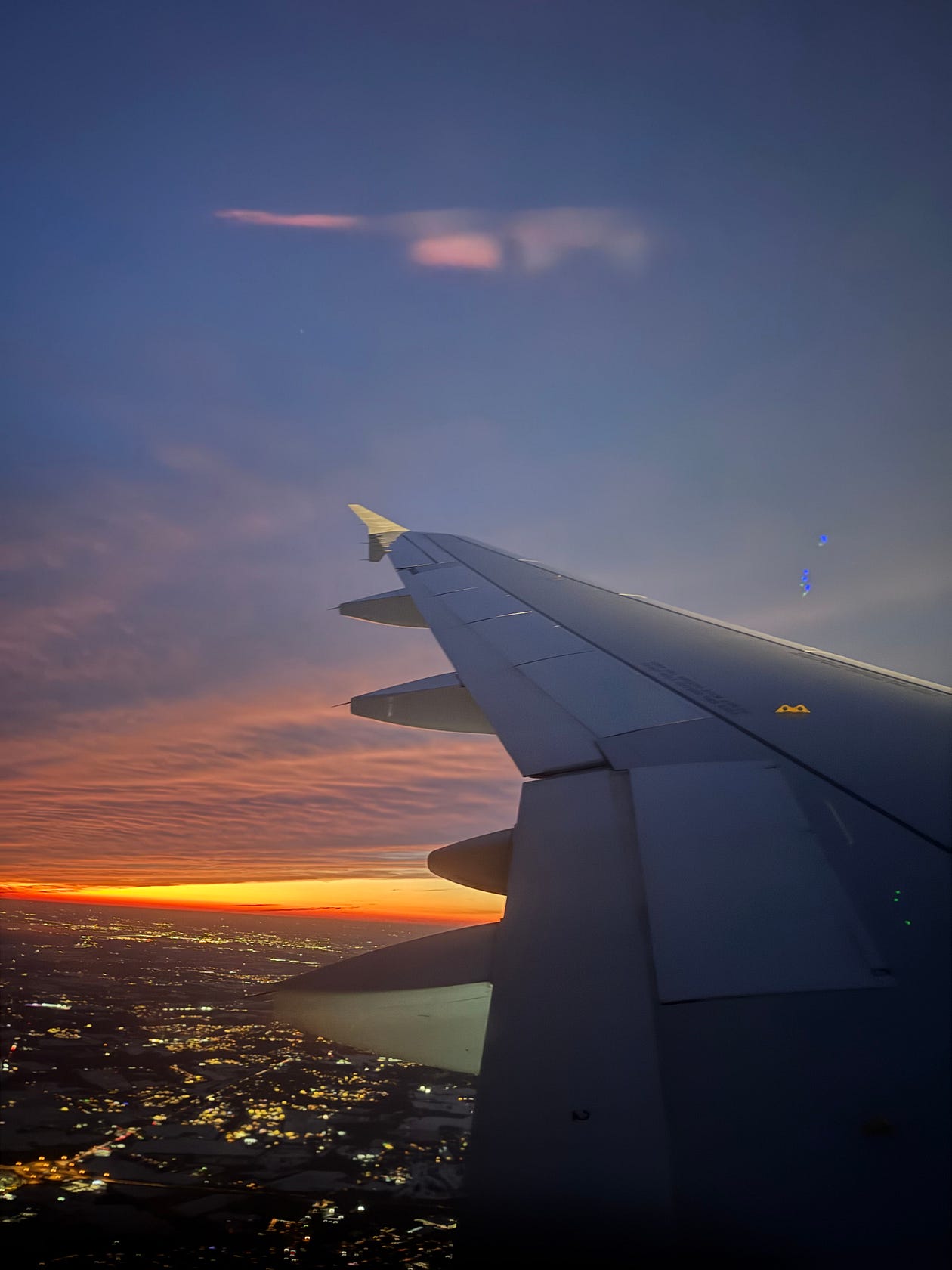
My partner and I were heading home from a six-week trip to Europe, and were looking forward to retirement and planning our next adventure. Our plane had just begun its journey across the Atlantic when the captain came on to say the words no one on an airplane wants to hear.
“Ladies and gentlemen, we have to turn around and make an emergency landing.” A sick passenger, not an airplane mishap, had prompted the unscheduled return to Europe. As fate would have it, Dublin was the closest airport.
We landed in the pouring rain. While the captain made his way through the cabin to update the passengers, I caught his eye and mentioned the rain.
His reply came straight from the mouth of a sarcastic leprechaun.
“It’s always like that here,” he said with a smile. “You can take Ireland off your bucket list.”
He had no way of knowing that Ireland wasn’t on my bucket list, and I almost took his advice to write off this unscheduled “trip” as having been there, done that.
But the Emerald Isle had patiently waited for me a long time, and she didn’t mind waiting a bit longer. Ten years ago, my partner and I had planned a trip there. My dad died that year, and we postponed the trip. In March 2025, my mom passed, and Ireland somehow made it to the top of our travel list.
Winter was the perfect time to go. The tourists would be basking in their beach vacations in Florida, and I would leave behind the grief and thoughts of spending the holidays without my parents to create new memories with the partner I adore.
Merry Christmas from Dublin
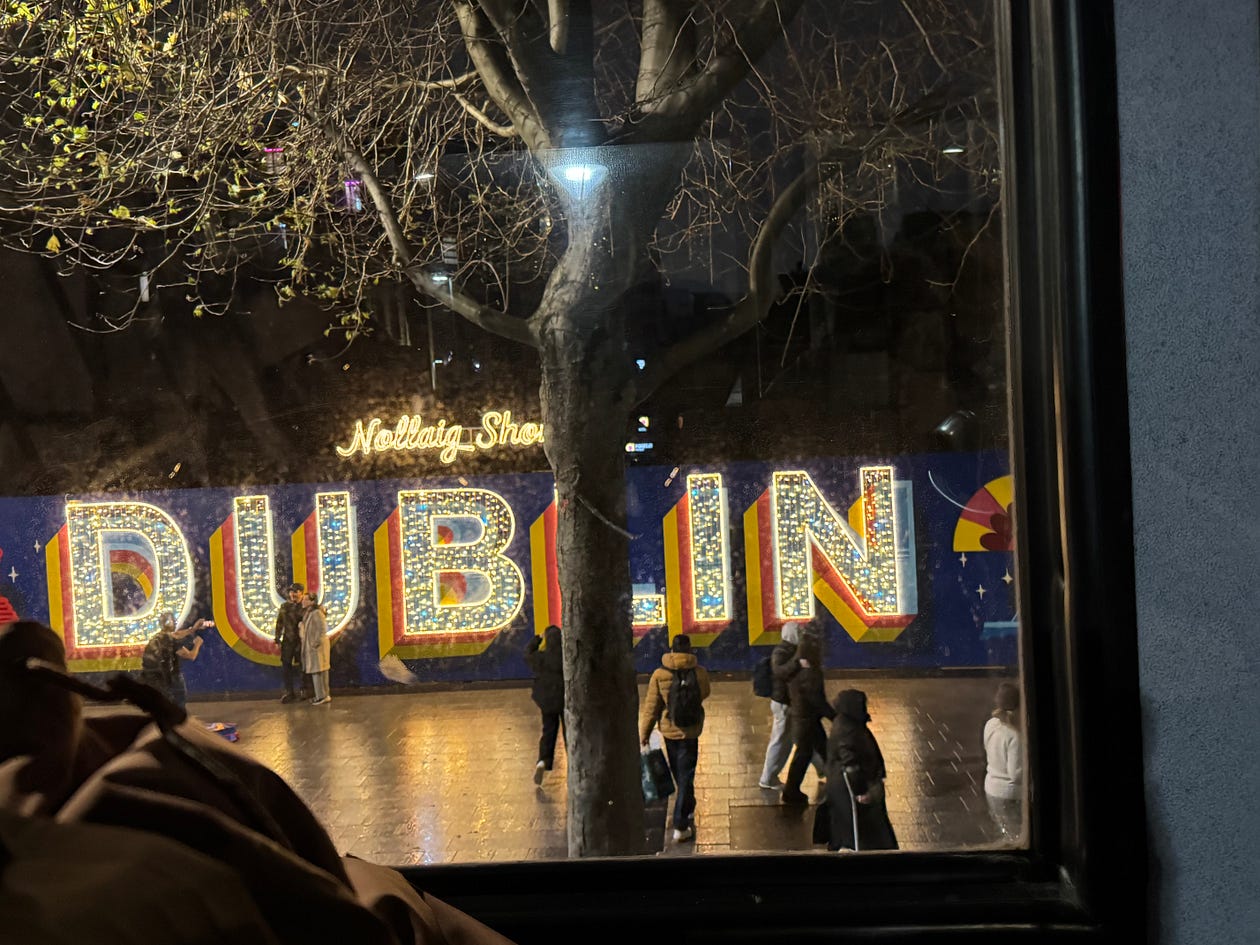
We landed in Dublin one week before Christmas. There were few, if any, tourists. But the throngs of people rushing to make last-minute purchases, the competing street musicians, and traffic that made Miami’s rush hour seem like a yoga retreat, were a far cry from the calm vacation I had anticipated. It was an empath’s worst nightmare.
It’s like every resident of Dublin heard we were there and had come out to greet us. Despite my aversion to crowds, however, I was drawn to the people around me. Everyone made eye contact. I smiled, and they smiled back. The children were polite. Even the dogs stopped to say hello.
Why is everyone so nice? I wondered.
After surviving the crowds, we headed to our first pub. The Irish have a reputation for being heavy drinkers. I don’t drink, so walking into a pub was a little intimidating. But you can now visit any Irish restaurant or pub and ask for anything from 0.0 Guinness to 0.0 gin, and the bartender won’t give you a dirty look. The supermarket shelves are stocked with dozens of alcohol-free beers, gins, tequilas, and even bottles of 0.0. Captain Morgan, proof that even pirates have designated drivers.
Although we are not fans of tours, the Book of Kells tour and a visit to the Jameson Distillery were more than worth the time and money we spent before heading north to celebrate Christmas at Lough Eske Castle in Donegal.
Christmas in a Castle and Not A Cloud in the Sky
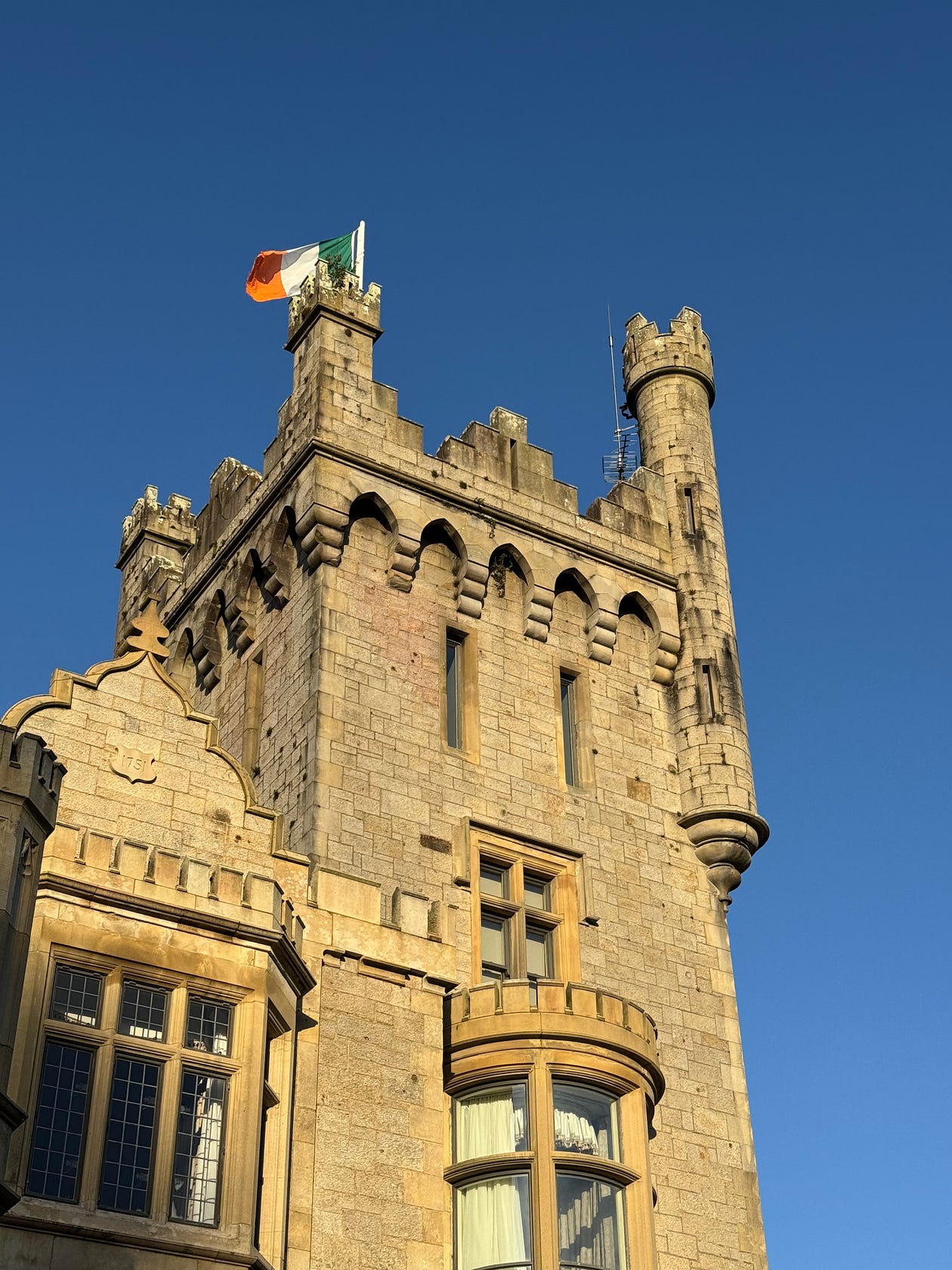
We arrived in Donegal under blue, cloudless skies. What, no rain? Ireland was clearly having fun with me.
The first morning at the castle, I was awoken by my partner’s very insistent voice.
“Barb, Barb, wake up!” she said. I thought for sure she was going to tell me that the Northern Lights, which had been active in the previous weeks, were putting on a show to welcome me to Ireland.
“What is it?” I asked, more than a bit concerned.
“Bunnies!” she replied, pointing to four bunnies that had been playing at the entrance to our cottage, but had pranced away as soon as I walked to the door.
Irish folklore considers rabbits as mystical, sacred creatures linked to the Otherworld, fairies, and shapeshifting witches who appear as beautiful women or cunning hags.
The bunnies were there the first day, never to reappear. Ireland had had her laugh with the little shapeshifters, and she had other surprises in store.
The four days at the castle were magical. It was the perfect way to celebrate my first Christmas after losing my Mom.
Derry and “The Troubles”
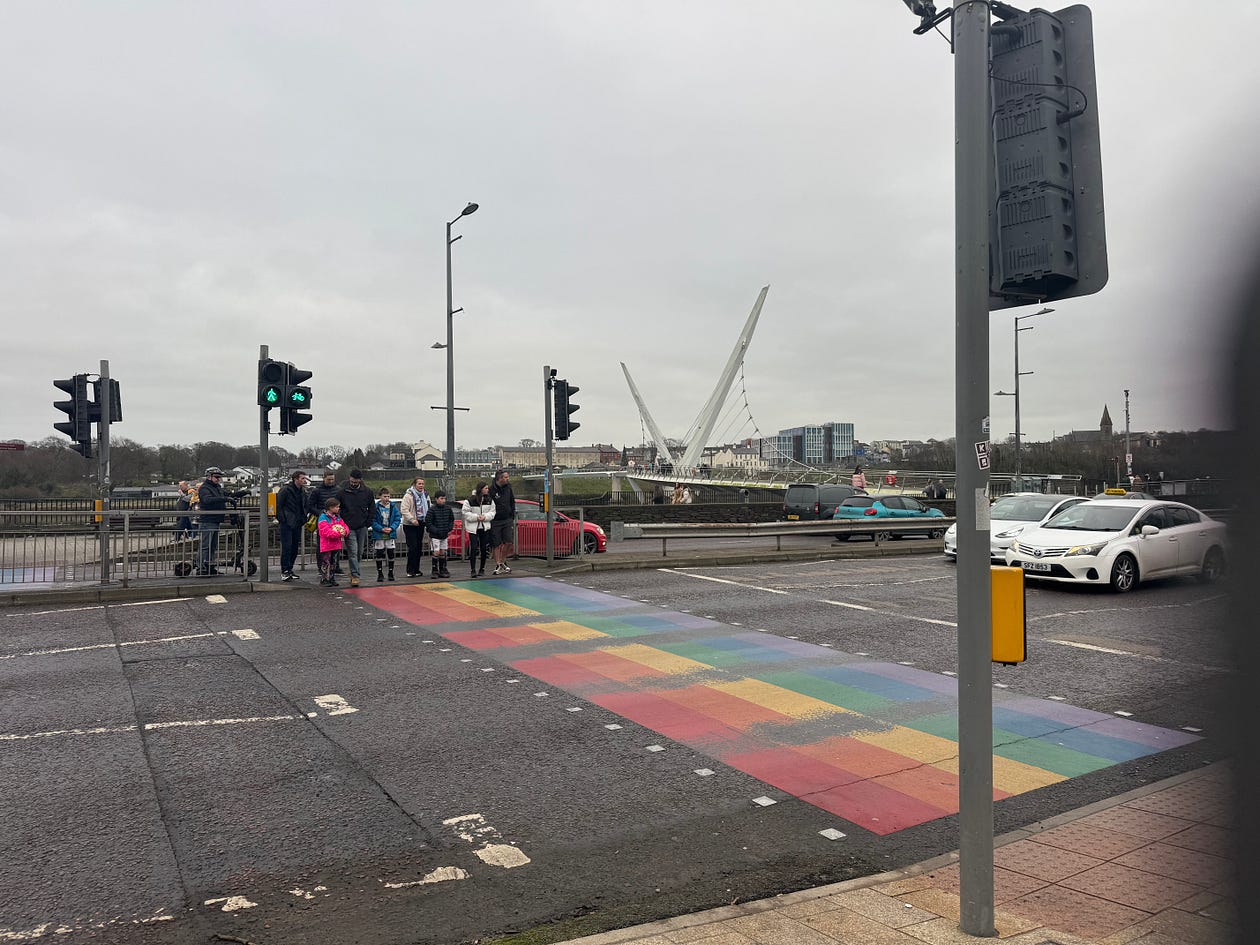
After three nights at the castle, we went to Derry (or Londonderry, depending on which side of the conflict that tore Ireland apart you sympathize with). Derry is in Ireland, but it’s not. It’s in Northern Ireland, a portion of Ireland whose history has enough conflict to put the Middle East to shame.
This article is not meant to be a history lesson on the conflicts that still exist despite the Good Friday 1998 agreement that ended “The Troubles,” violence that divided Ireland for two decades. But visiting Derry is like walking into a history class.
The Peace Bridge in the city was built to connect the Protestant east bank and Catholic west bank of the River Foyle, symbolizing unity after the conflict. Its crooked design stands as a landmark of peace and shared space. It’s a reminder that the road to peace isn’t a straight line.
Seeing a rainbow flag painted on the crosswalk heading to the Peace Bridge was an especially poignant moment for me. A city famous for conflict has grown to accept and welcome everyone.
It’s in Derry that I struck up a conversation with a young woman who walked into a small shop we had gone into looking for, of all things … Claddagh rings. She just happened to be walking a dachshund (my spirit animal) and was going to New York for the first time the following week.
She asked me where she should go on her first visit to my former home city.
“Let the city take you where she wants to take you,” I replied. The words came out of my mouth, but they weren’t mine. I was a vessel speaking them, but they were Ireland’s voice telling me to trust her, drop my expectations, and follow where she would lead.
And then there were the Derry Girls, a three-season Netflix series that I had somehow missed. It’s a comedy based on the conflict in Northern Ireland, a time capsule that tells the story through the eyes of a group of high school girls who lived it. A huge mural of the girls is painted on a wall in Derry. Out of curiosity, I started watching the series. And I couldn’t stop.
Nothing beats binge-watching all three seasons of The Derry Girls while in Derry.
New Year’s Eve in Belfast
Belfast was also the scene of much of the violence in Northern Ireland in the ’70s and ’80s. Like Derry, it is part of Ireland, but it’s in the U.K., not in the Republic of Ireland. Belfast is where we planned to welcome in the new year. I was never a fan of the holiday, but Belfast changed the way I think about New Year’s Eve forever.
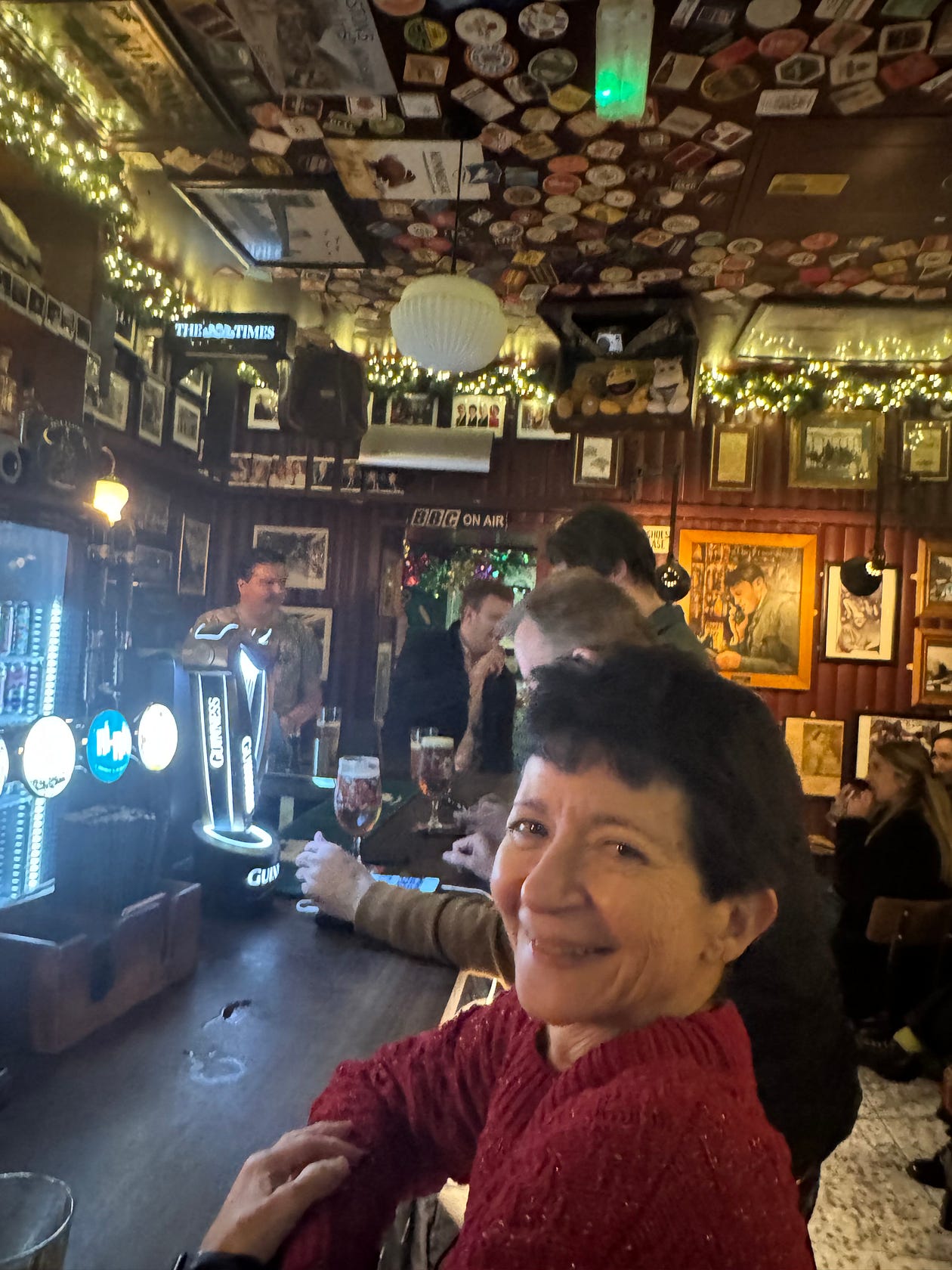
Not knowing how we would spend the night, my partner and I wandered into the Cathedral Quarter and into a tiny pub called The Reporter.
Its journalism-themed walls stirred memories of my own past career, while the city outside reminded me of Belfast’s complicated history and enduring spirit. The pub was intimate, welcoming, and free of overwhelming crowds — the exact opposite of the New Year’s celebrations I had always avoided.
As music filled the room and midnight arrived, I felt an unexpected calm settle over me, grateful for where I was and who I was with.
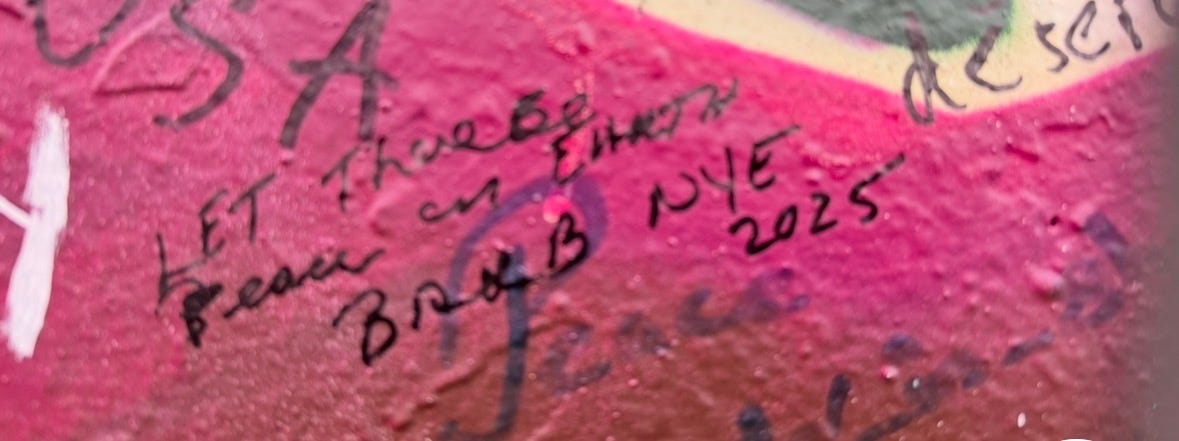
The next day, I signed a New Year’s message on the Peace Wall, a site where visitors to Belfast add their own messages of peace and solidarity.
Other memorable stops in Belfast included the Europa Hotel, a hub for journalists covering the conflict in Northern Ireland. We also visited the Titanic Experience, an immersive experience museum that tells the story of the shipyard where the Titanic was built and her departure from Belfast on April 2, 1912, to begin her fateful maiden voyage to New York.
The Wild Atlantic Way
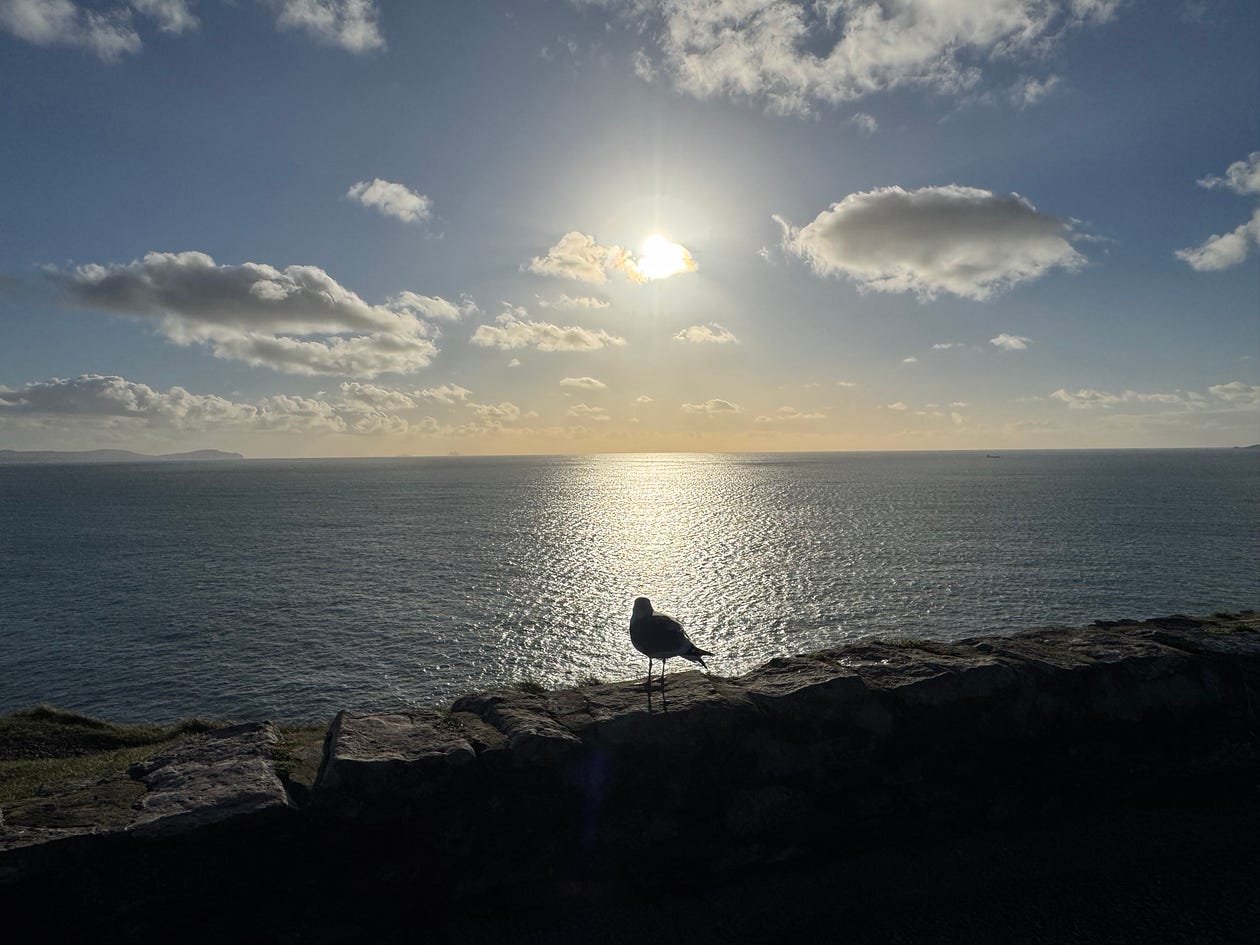
We made a couple of other stops, including Kilkenny and the coastal village of Kinsale, before heading to the southwest coast.
Our penultimate stop was Brandon, a tiny village in County Kerry on the Dingle Peninsula, population 100, home of Mount Brandon, one of Ireland’s highest peaks. It’s here that the Irish language is still spoken, and its residents speak English with an accent so thick that when I ordered coffee at one of the only coffee shops open for the season, the waiter said something to me, and I told him I didn’t speak Irish. He had to repeat himself three times before I understood that he was asking me, in English, if I wanted milk with my “Americano.”
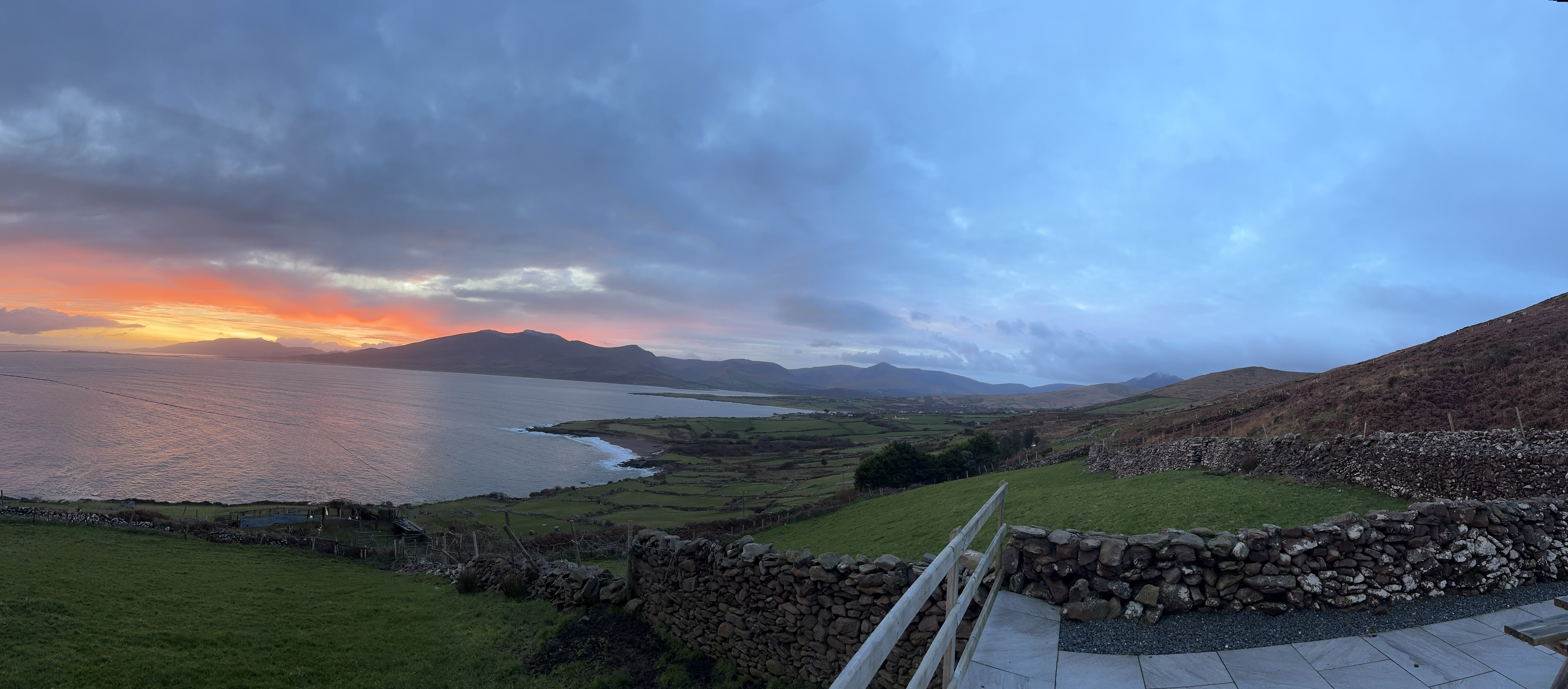
The Dingle Peninsula is heaven on earth. You have to experience it to know what it feels like to be there.
It’s like God woke up on the eighth day and said, “I think I’ll show off today.” And the Dingle Peninsula was created.
Mount Brandon is spectacular. It’s named in honor of St. Brendan, an Irish saint famous for helping spread Christianity throughout Ireland. He is closely tied to the Dingle Peninsula, where he was born and established early monasteries.
St. Brendan is known as The Navigator, and is often shown holding an anchor. I didn’t know the story of St. Brendan until I read about it while perusing an article online during our second night in Brandon.
Fifty years ago, I attended St. Brendan High School. Some of the greatest memories and friendships in my life were born at St. Brendan. I now understand why our school’s yearbook was called The Anchor.
I had made a pilgrimage to the place where the saint after whom my high school was named had begun his mission. It was another “coincidence,” another piece of my Irish puzzle, that fell into place during this trip.
A Winding Path to the Unexpected
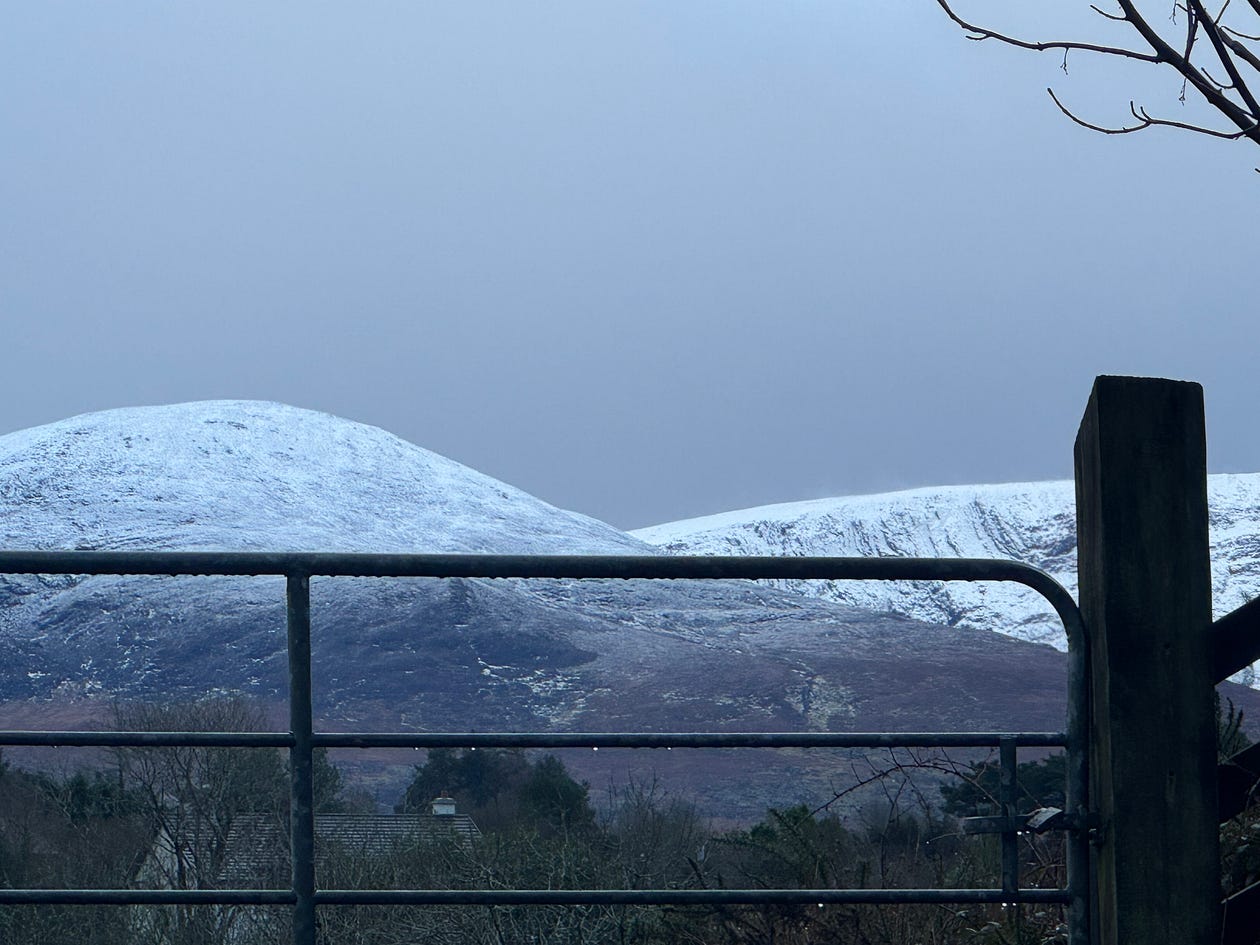
Just when we thought Ireland had given us her all, she reached out her hand and said, “I saved the best for last.”
As she guided us through the winding path along the Dingle Peninsula’s Slea Head Drive, snow-covered peaks as far as the eye could see morphed into green valleys that gave way to brown winter-scarred vistas. One moment, we were standing firmly on God’s earth. Next, we were Neil Armstrong landing on the moon, the landscape stretching around us like the Sea of Tranquility.
It’s like God woke up on the eighth day and said, “I think I’ll show off today.”
Humans had abandoned the planet and had been replaced by flocks of sheep. They came out of nowhere, prancing through the fields and blocking the path of our little blue car that dared to intrude on their trail. It was a biblical rush hour, forcing us to slow down and inhale the scenery that enveloped us.
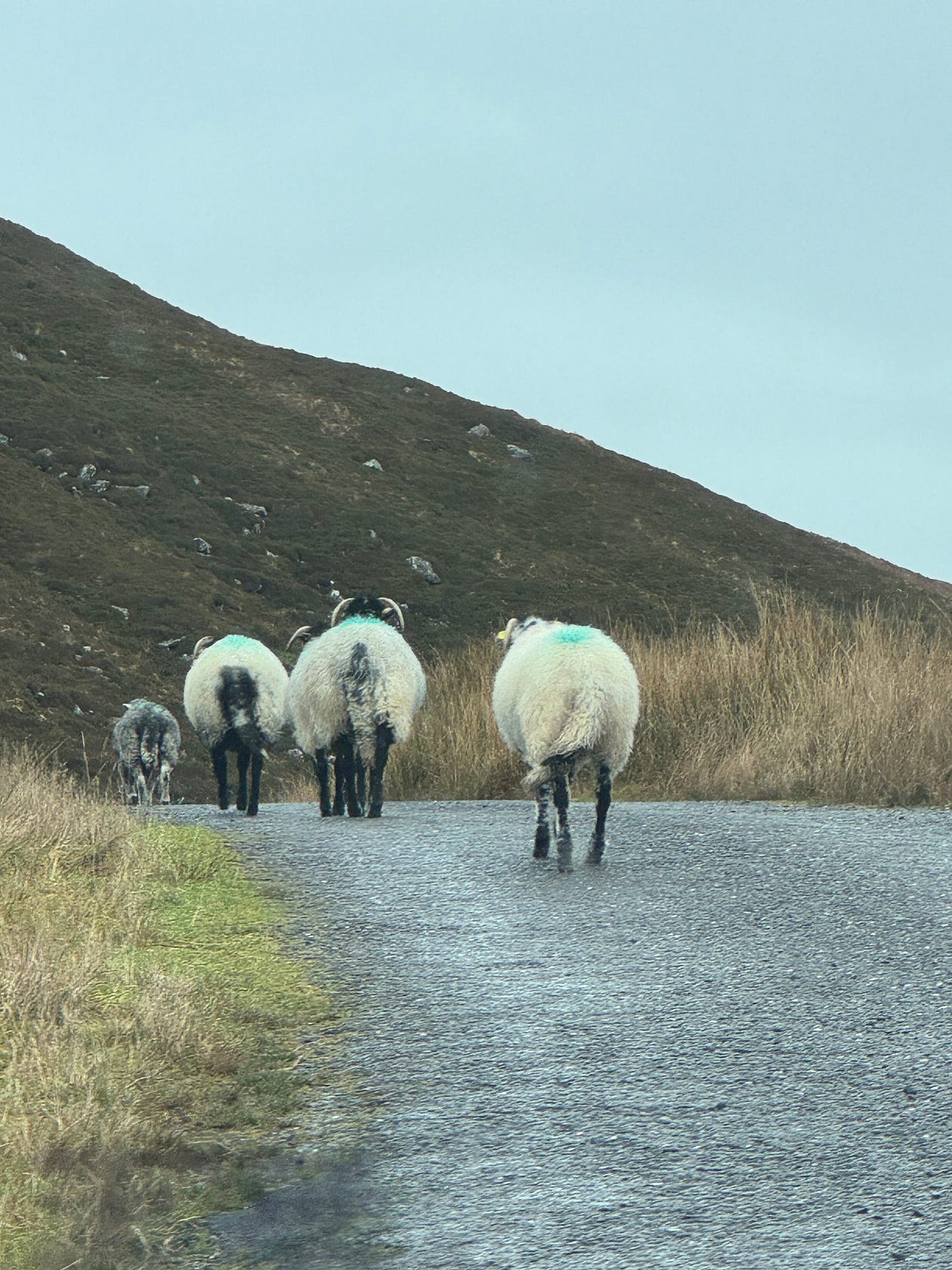
Hundreds of sheep grazed in the hills above the narrow path. I was awestruck. The most profound question I could dream up in that moment, driven by childlike curiosity, was, “What keeps them from tumbling sideways from those steep hills?”
My partner and I have always preferred taking the scenic route over the fastest. This entire area of Ireland is a scenic route. The question is not, “Should I take the scenic route?” It’s “Which scenic route should I take?”
With winds whipping in every direction and sheets of rain pelting the landscape into submission, it’s no wonder the western coast of Ireland is called the Wild Atlantic Way.
Avoiding the Tourist Traps
Ireland brought us to all the magical places she wanted to show us. But we passed on seeing two of the country’s biggest tourist attractions.
My apologies to those who have had moving experiences at the places the guidebooks say are “must-sees.” I’m not a “gotta see what everyone says I gotta see” kind of gal.
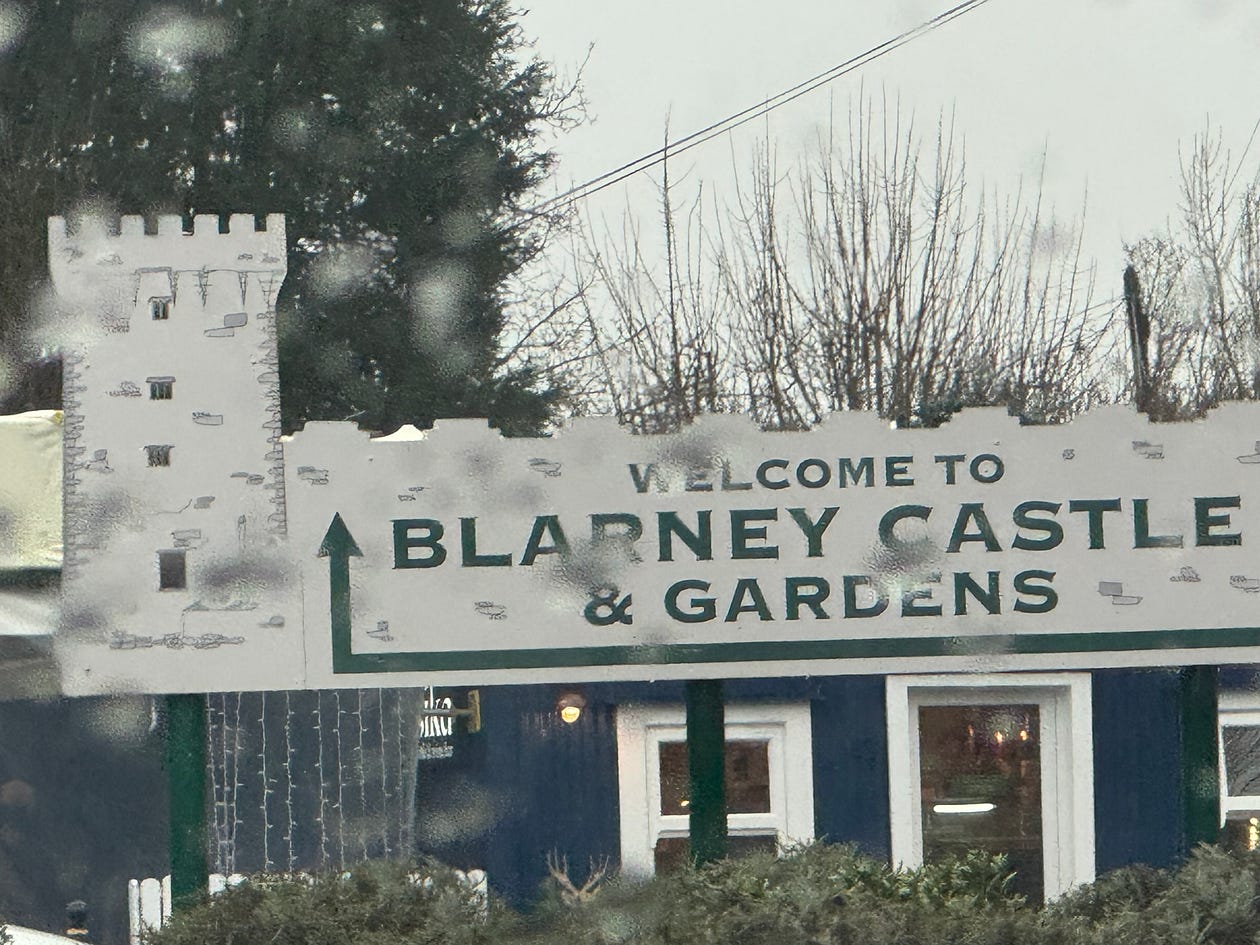
We had all intentions of bending over backwards to kiss the Blarney Stone. Legend has it that kissing the stone gives you the gift of gab. We drove to Blarney Castle, got lost several times, arrived at the castle entrance, and it started to rain, a sign from above that even legends deserve a day off. Or maybe it was Ireland’s way of telling me that I talk too much.
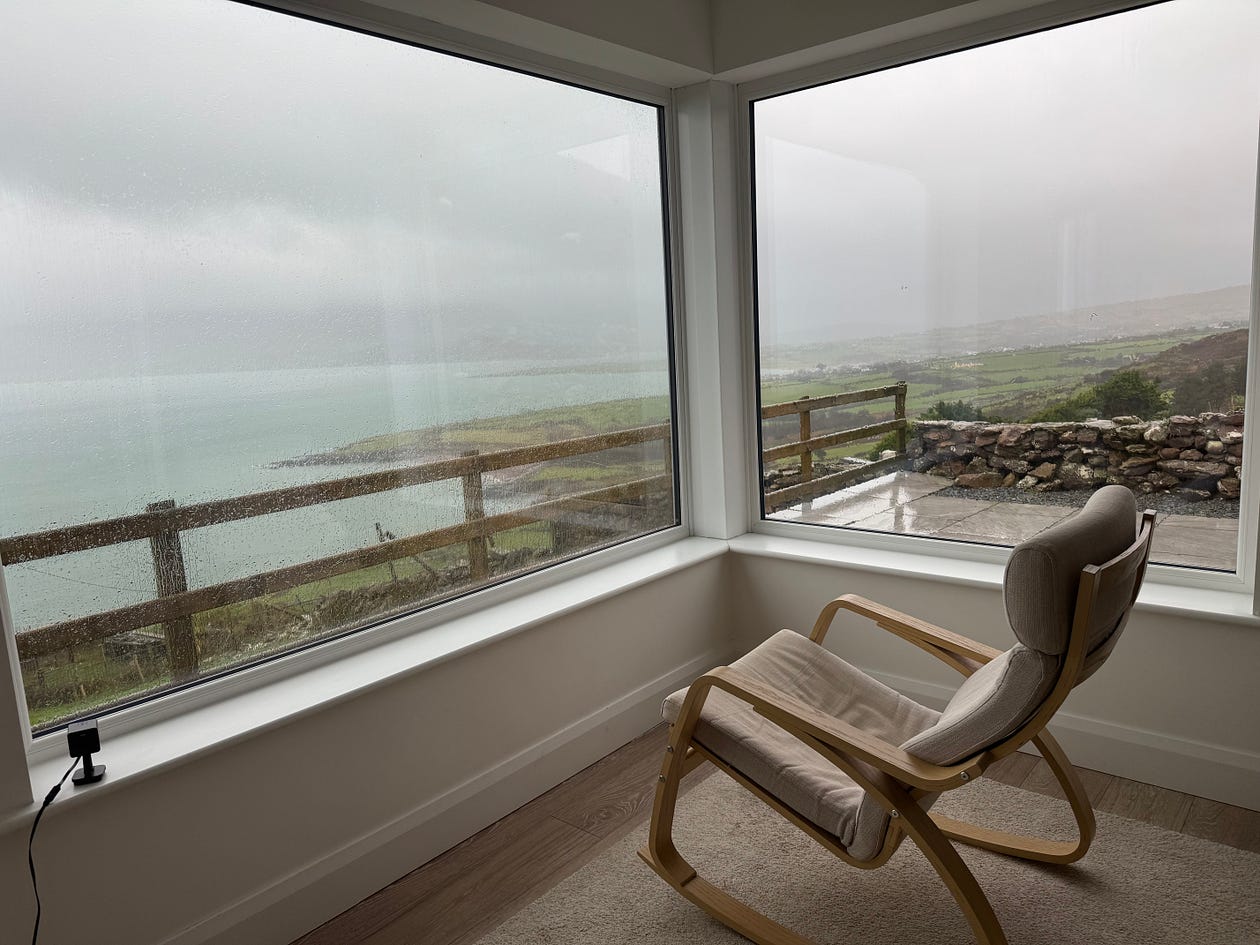
We had also planned to drive around the Ring of Kerry, a 111-mile scenic drive about an hour from where we were staying. But the winds that had kept us up the night before our scheduled departure were relentless into the next morning. We took it as a sign to relax and enjoy the show Mother Nature was putting on for us from the bay windows that surrounded the house we had rented for the week.
As if we needed further confirmation that we had made the right choice, a book titled “What Not to Do in Ireland” caught my attention from a small bookshelf in the living room. Visiting the Ring of Kerry was one of them.
The Pot of Gold
Those are just a few of the highlights of the month my partner and I spent in Ireland. I could write a series of books on the things we saw and felt in that short amount of time, and they still wouldn’t do justice to the gifts this country gave us.
Irish folklore says leprechauns are clever little fairies who hide their pots of gold at the end of rainbows, guarding the treasure with tricks so no one can claim it. It’s a tale of mischief, magic, and the promise of fortune always just out of reach.
After a rain shower just before we left Dingle, a rainbow appeared. I could hear the little fairies laughing in the background.
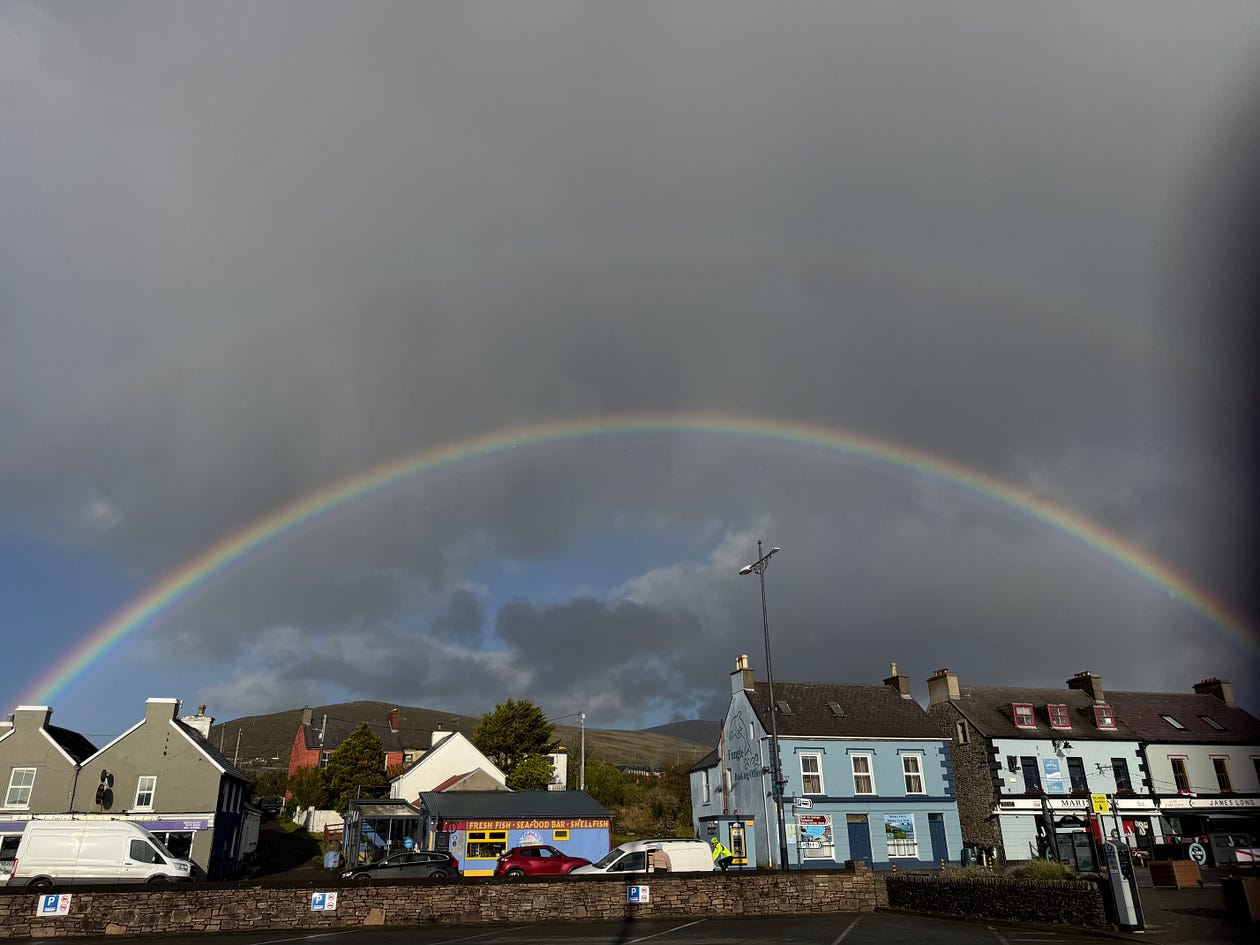
Once you start chasing the dreams on your bucket list, new ones appear, and the journey itself becomes the greatest wish of all.
I found the pot of gold at the bottom of my bucket list. I also found a four-leaf clover. Her name is Ireland. She was never on my bucket list.
I will be eternally grateful that I was on hers.
 Trading Barbs With Barb